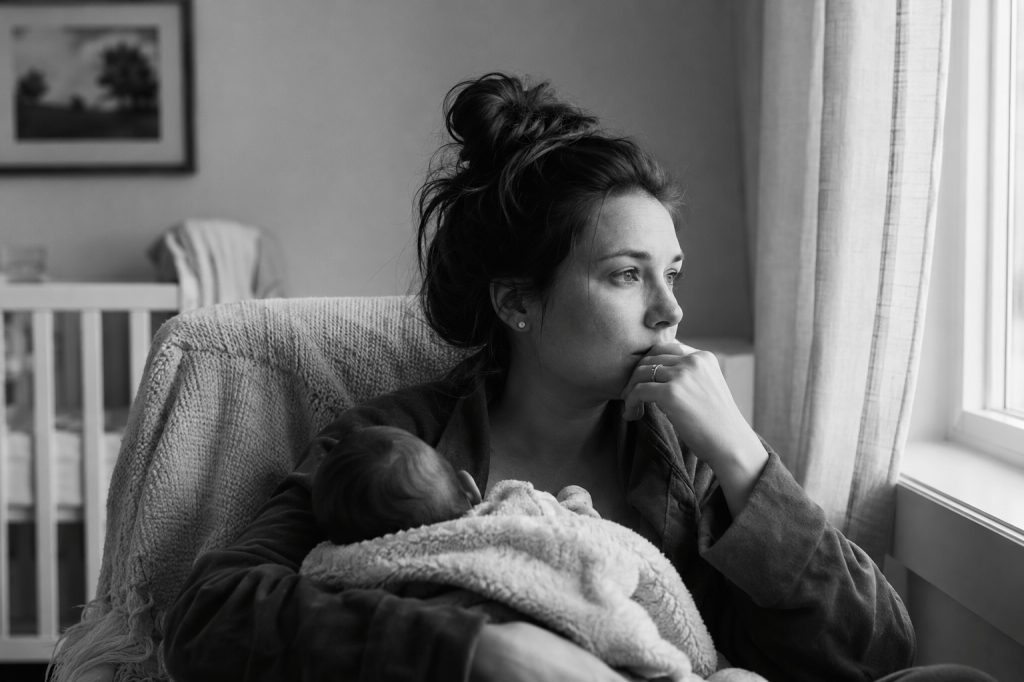
• AI Generated Image

    New motherhood is a journey of self-discovery. And by no means do I claim to know it all. In fact, the older I get, the more I realize I don’t really know anything. But I have started to notice a few positive patterns emerging in my life since becoming a mom—and here are three of them.

    First, I’m turning my back on perfectionism.

    I no longer feel like I need a spotless house. I no longer feel like I need more stuff. When I had my daughter, I was introduced to a kind of love I had never felt before—the purest form of love I think we can experience as humans. And somehow, both slowly and all at once, it made me realize that all the extra noise we fill our minds (and our Pinterest boards) with… doesn’t actually matter.

    It’s just distraction. A way to cope.

    I’m a recovering perfectionist, and for a long time I used perfection as a shield—thinking if I could just do everything right or be perfect in my interactions, I could avoid feelings like shame or pain. But that’s not real life. It’s a setup for failure.

    Motherhood triggered that perfectionism in me—but it also forced me to confront it. I couldn’t carry the weight of perfectionism and fully embrace the beauty of motherhood at the same time. Something had to give.

    So now, I’m choosing what actually matters. Real relationships. Less stuff. Leaving the dishes in the sink sometimes. The more bullsh*t I cut out, the more space I have for what’s real.

    Second, I view money differently.

    Kids are not cheap. And if I’m not careful, I can easily fall into the trap of buying a new set of cute onesies every time my daughter sizes up. There are the obvious expenses—car seats, formula, doctor visits—but also the sneaky ones: pool toys, stroller fans, teething popsicles. It adds up fast.

    Lately, I’ve started thinking about money the same way I think about calories. It’s easy to spend and hard to earn back. You can drop $10, $20, $50 without thinking—but it can take hours of work to make $200. The ratio doesn’t always make sense.

    And let’s be real—it’s 2026. Inflation is wild.

    Being responsible for my daughter has made me want more control over where my money goes. I’m taking that control back. I’m spending with intention. I’m buying secondhand when I can. Because at the end of the day, it’s not about having more—it’s about being smarter with what I have.

    And third, I’m doing more things that scare me.

    I don’t want my daughter to grow up paralyzed by fear. I want her to understand that scary things are a part of life—and that we can still choose courage anyway. But I can’t teach her that if I’m not living it myself.

    Growth doesn’t happen in comfort. It happens when we push ourselves.

    The other day, my new mom friend across the street invited me over for a playdate. And honestly? That kind of thing terrifies me. I’m a true introvert. My first instinct was to curl up in a corner and avoid it completely.

    It’s not that I’m antisocial—I can be outgoing when I need to be—but it takes a lot out of me. I need time alone to recharge. So the idea of a vulnerable, get-to-know-you playdate felt like a lot.

    But I went anyway.

    Because I knew I needed to. For my own growth, and honestly, to start building a community. And you know what? It was great. Not awkward. Not overwhelming. Just… easy. My daughter got to interact with another baby, and I stepped outside of my comfort zone.

    Win-win.

    Motherhood is stretching me in ways I didn’t expect—but maybe that’s the point. Maybe it’s not about having it all figured out. Maybe it’s about letting it change you.
  • If I’m aware, I can catch myself thinking, “I should be softer,” or “Why don’t I know the words to any nursery rhymes?” Or my personal favorite: “You should be speaking a foreign language to your baby right now.” (Spoiler alert: I only speak English)

    Why do we put this pressure on ourselves to be the perfect mom? Where is it coming from?

    I’d guess some of it comes from wanting to outdo our parents—to halt the generational patterns that caused us pain. (Mom, if you’re reading this, I know you were just doing the best you knew how.) And the rest of it? We just don’t want to mess up our kids.

    It wasn’t about 2–3 hours after giving birth, I had already made parenting mistakes. Maybe 2–3 weeks into motherhood, I started to accept that I’m flawed—and that I would keep making mistakes. And maybe 6–7 months postpartum, I learned to embrace it, if you will.

    Somewhere along the way, I welcomed the messy.

    I stopped trying to keep my house perfectly clean. I stopped caring if all my baby’s toys were beige. And I mostly stopped listening to my own worst critic. But, what was motherhood going to look like for me?

    Being catapulted into new motherhood forced me into a deep kind of self-reflection. I teach little ones, so I know how brutally honest kids can be. They see you—really see you. And I knew my daughter would see me, too. She would see me exactly as I am.

    And that scared me.

    It made me ask, Who am I? What am I good at? What actually matters to me?

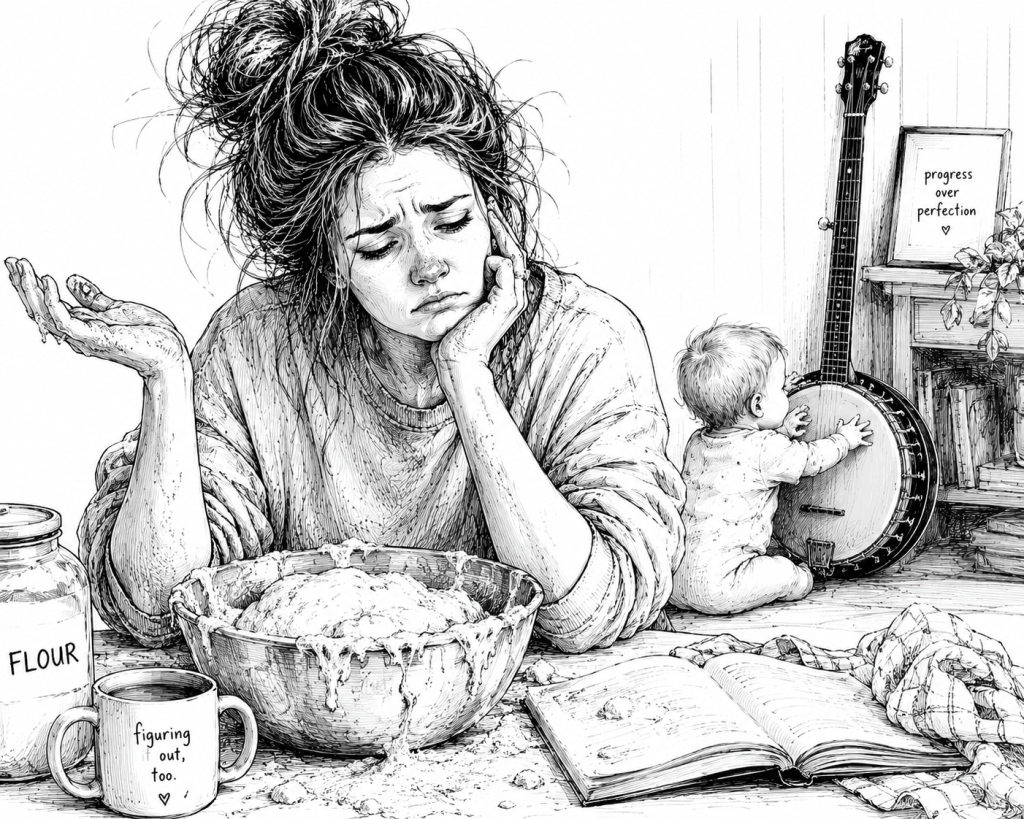
    Before I even realized what was happening, I spent months in a whirlwind of self-discovery. I started sourdough, gardening, and even banjo lessons—all while navigating diapers, feeding schedules, and sleepless nights. Crazy, right?

    At the time, I didn’t fully understand it. Part of me thinks I was avoiding something—avoiding some really big feelings.

    Either way, I had taken on too much. I was to trying to be “complete” before my daughter could see who I really was… talentless, anxious, and covered in stretch marks.

    I could never live up to that type of pressure.

    All of this to say: somewhere along the way (probably sick and tired of all the failed sourdough bakes) I realized my daughter was going to love me exactly as I am.

    Everything I hadn’t learned yet? We could learn it together. And she wouldn’t respect me any less for not knowing it before becoming her mom.

    My daughter would see a person that was allowed to make mistakes. Messy mistakes too.

    And if I want to clean my house and keep all beige toys, I’m allowed to do that too.

    If I spend half the day in my head instead of fully present, that’s okay too.

    All of it is going to be okay.

    Because at the end of the day, I am the one who gets to offer myself grace.

    And the sooner I came to terms with the fact that social media, comparison, and my own shame were quietly defining what motherhood should look like, the sooner I was able to let go.

    Let go of the expectations.
    Let go of the noise.
    Let go of the version of motherhood that was never really mine.

    And in that space, I was finally able to see my daughter—

    the way she has always seen me.

  • There are so many things I wasn’t told before having my sweet baby daughter, Charlie.

    And I don’t mean the obvious things—like sleep deprivation or diaper blowouts (although… we’ll get to that). I mean the hair pulling- I love this baby more than anything- holy crap there’s no pausing this- part of new motherhood. The part no one really talks about.

    Also, no one really prepares you for the in-between—the long stretch of pregnancy where you’re not quite “there” yet, but everything already feels like it’s changing. Honestly, it felt like the doctor’s office didn’t even take me seriously until I was 38 weeks pregnant. I’m serious. It felt like I was just left floating in no man’s land.

    I remember thinking, “Don’t you want to check me? One ultrasound? One test? Something?”

    But for weeks, there was nothing—just, “Come back when you’re further along.”

    And then suddenly… you’re sent home with a newborn and a thousand questions.

    There’s this huge gap. No real guidance on how to care for a baby. No real direction for what postpartum actually looks like. It makes you wonder—who is responsible for preparing women for motherhood?

    Because that’s what it felt like.

    Like I was expected to figure out how to care for a newborn while also navigating one of the biggest emotional and physical shifts of my life.

    Postpartum hit me like a tidal wave.

    Of course, I had heard of postpartum depression. I knew it was real. But I didn’t understand it—not really. I didn’t know that within the first 24 hours after birth, a woman’s estrogen and progesterone levels can drop by up to 90%.

    No one told me that.

    No one told me that what I would feel wasn’t just emotional—it was chemical. Biological. Real in a way I had never fully grasped before.

    At the same time, I felt a love for my daughter so overwhelming I can’t even put it into words. It was beautiful… and it was terrifying. Everything suddenly had new meaning.

    I was exhausted.

    I felt like I was failing.

    My life—what felt like my very DNA—had changed in an instant, and I needed a moment. A long moment to process it all.

    But there was no time to step away.

    So I just kept moving forward.

    And somewhere in the middle of all of that… this idea started forming.

    I didn’t start this blog because I had it all figured out.

    I started it because I had a baby—and suddenly realized how different I was going to be. How I was going to feel everything at once. Love someone so much it actually hurt… and still somehow feel completely undone.

    It’s me, Danielle. A 34-year-old woman navigating being a mom.

    There’s so much I want to say about it—the joy, the exhaustion, the identity shift—but the truth is, I didn’t just start this blog for connection or as a creative outlet (even though those motivations are present).

    Being transparent here… I created it as a means to an end. A specific end.

    I want to stay home with my daughter.

    I want to quit the 9–5 and actually witness her childhood.

    And right now, that “choice” feels more like a luxury than ever.

    So this blog?

    This is me figuring it out in real time.

    The mess.
    The meaning.
    The money.
    The moments in between.

    One post at a time.